
The history of the Smallpox Hospital is also the history of smallpox.
Built in 1856 to isolate and treat people with smallpox, the hospital was part of New York’s effort to control a disease that repeatedly swept through the city. The building later became a nursing school. As vaccination transformed public health and smallpox was eradicated, the building lost its purpose and was eventually abandoned.
The disease is gone. The building remains.
The vaccine
Edward Jenner tests cowpox against smallpox
Jenner inoculates eight-year-old James Phipps with cowpox. Two months later, Phipps is exposed to smallpox and does not become ill.
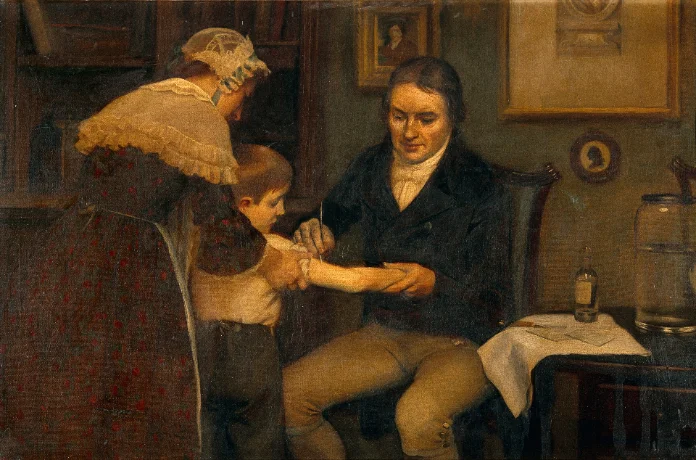
Jenner performing his first smallpox vaccination on a child in 1796, Science History Images
New York begins vaccinating
New York City begins a program of smallpox vaccination. The vaccine offers a way to prevent the disease, but outbreaks continue.
New York acquires Blackwell's Island
New York City purchases Blackwell's Island for $32,000 and begins developing it as a site for institutions, including hospitals and prisons.
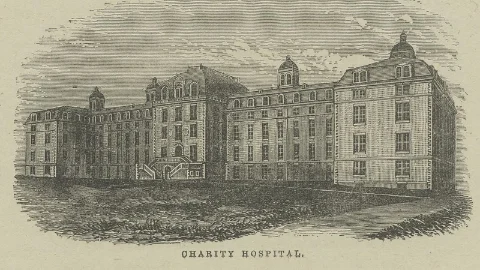
New York Public Library
The island · Minnahanonck to Roosevelt
The island the city used for the institutions it did not want on Manhattan.
A penitentiary, an asylum, an almshouse, and hospitals for contagious disease — and, since 1969, a residential neighborhood with a tram, a subway stop, and Four Freedoms Park. The ruin stands at its southern end.
Smallpox remains a major cause of death
A large unvaccinated population leaves New York vulnerable to recurring outbreaks. In 1850, smallpox accounts for 25.4 of every 1,000 deaths in the city. A New York State report describes the city's smallpox facilities as “a pile of poor wooden outhouses on the banks of the river.”
Construction begins
New York begins construction of a permanent smallpox hospital on Blackwell's Island, designed by James Renwick Jr. The hospital is the first major U.S. hospital built specifically for the treatment and isolation of people with smallpox. Prisoners on the island quarry, cut, dress, and lay the stone.
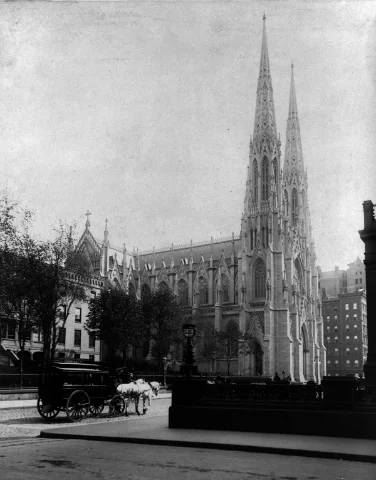
Library of Congress
The architect · 1818—1895
He was designing St. Patrick's Cathedral at the same time.
Renwick was engaged to design the cathedral in 1853, one year before ground was broken here. Grace Church, the Smithsonian Institution Building, the Corcoran Gallery, and Vassar were his as well.
Smallpox Hospital opens
The hospital is completed on December 18 at a cost of approximately $38,000. Its location, separated from Manhattan by the East River, allows the city to isolate people with smallpox from the rest of the population.
The hospital and nursing school
The old smallpox hospital burns
The wooden buildings previously used for smallpox patients are destroyed by fire. Patients move into the new stone hospital on January 3.
The hospital becomes Riverside Hospital
The Board of Health assumes control of the hospital and renames it Riverside Hospital. Its patients now include people with diseases other than smallpox.
The building becomes a nursing school
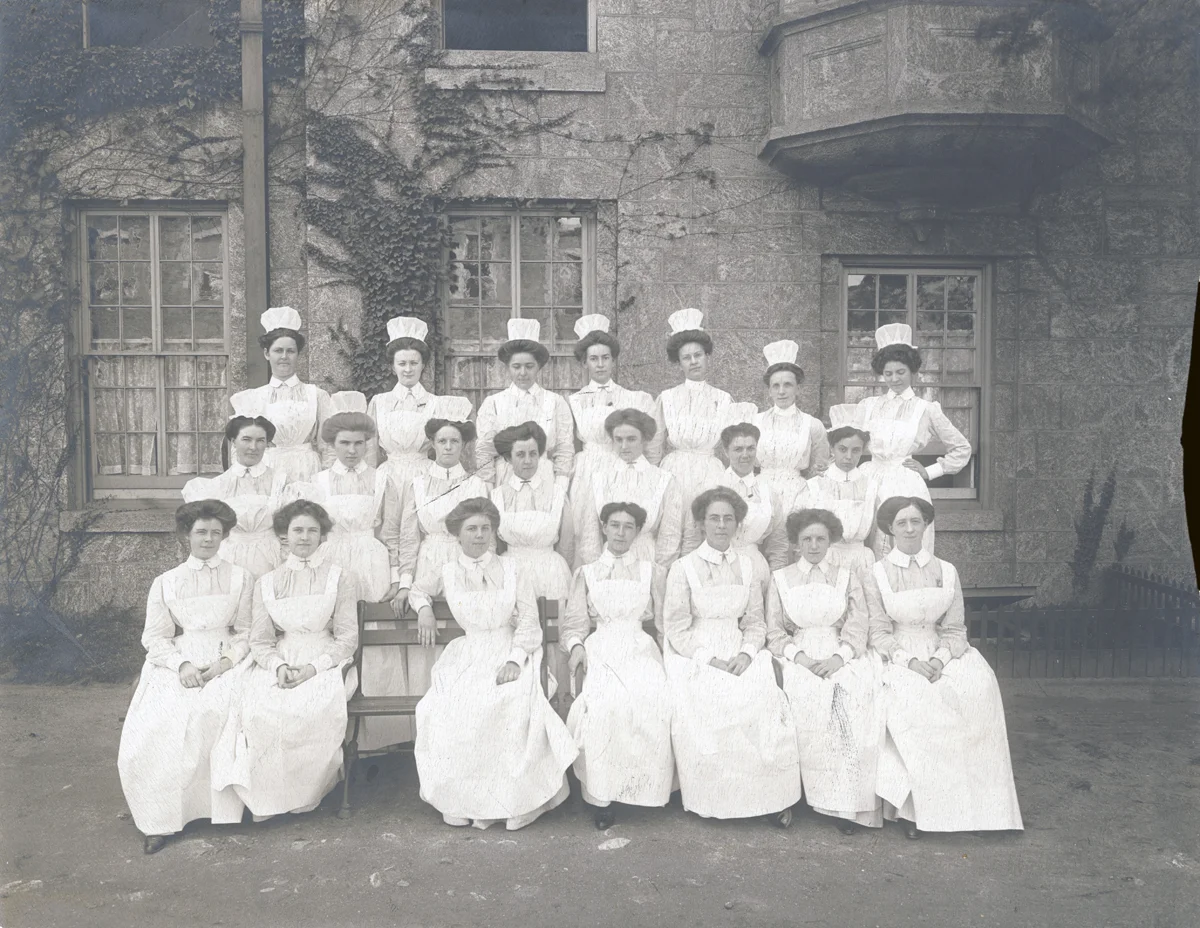
Riverside Hospital closes and its patients move to North Brother Island. The stone building is stripped and rebuilt as the Home for Nurses of Maternity and Charity Hospital Training School.
James Renwick Jr. dies
Renwick dies on June 23. He is buried at Green-Wood Cemetery in Brooklyn.
The nursing school expands
New wings add classrooms, dormitories, and training wards. The south wing is designed by York & Sawyer and completed in 1904. The north wing, designed by Renwick, Aspinwall & Owen, follows in 1905.
The Supreme Court upholds compulsory vaccination
In Jacobson v. Massachusetts, the U.S. Supreme Court upholds the authority of states to require smallpox vaccination to protect public health.
The island changes
Blackwell's Island becomes Welfare Island
The city renames Blackwell's Island Welfare Island.
The disease recedes
Smallpox returns to New York
A traveler arrives in Manhattan carrying smallpox. Twelve people become ill and two die. The city vaccinates approximately 6.35 million people in less than a month.
The last U.S. case
The United States records its last naturally occurring case of smallpox.
The building is abandoned
The nursing school moves elsewhere and the building is abandoned. The city begins depositing landfill south of the hospital. Over the next three decades, the island grows by approximately five acres.
The world commits to eradication
The World Health Assembly adopts a resolution calling for the worldwide eradication of smallpox.
The ruin begins to deteriorate
Water enters through the roof. Plaster falls, windows break, and vegetation takes hold. The Landmarks Preservation Commission identifies the building among the island structures worthy of preservation.
WHO launches an intensified eradication campaign
The World Health Organization launches its Intensified Smallpox Eradication Programme under Donald A. Henderson. The campaign expands vaccination, case finding, outbreak response, and international cooperation.
The building is stabilized, then opened to the sky
New York State hires architect Giorgio Cavaglieri to stabilize seven historic structures on the island. The Smallpox Hospital's roof is removed around 1971, leaving the stone shell open to the sky.
The ruin enters the National Register
The Smallpox Hospital is listed on the National Register of Historic Places.
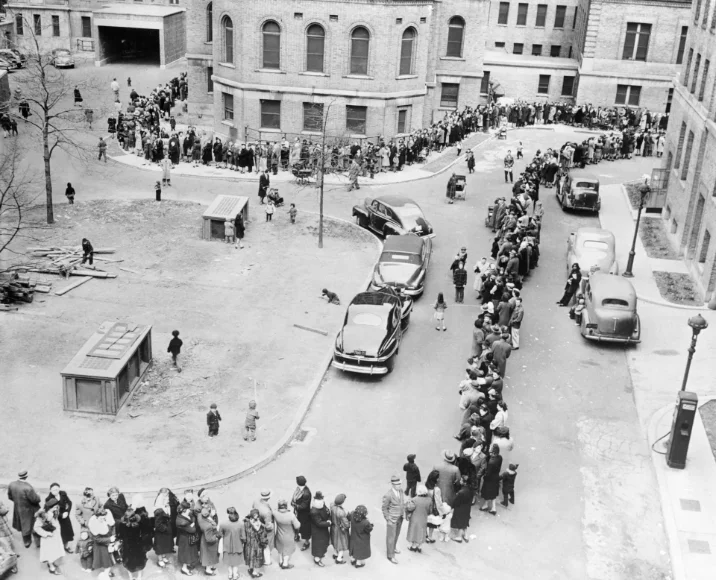
New Yorkers waiting to receive their free smallpox vaccinations outside Morrisania Hospital, Ossie Leviness
The ruin
Welfare Island becomes Roosevelt Island
The island is renamed Roosevelt Island in honor of Franklin D. Roosevelt.
The last person to survive variola major
Rahima Banu, a three-year-old girl in Bangladesh, becomes the last person known to contract variola major, the more severe form of smallpox. She survives.
New York City designates the ruin a landmark
The Landmarks Preservation Commission designates the Smallpox Hospital a New York City Landmark.
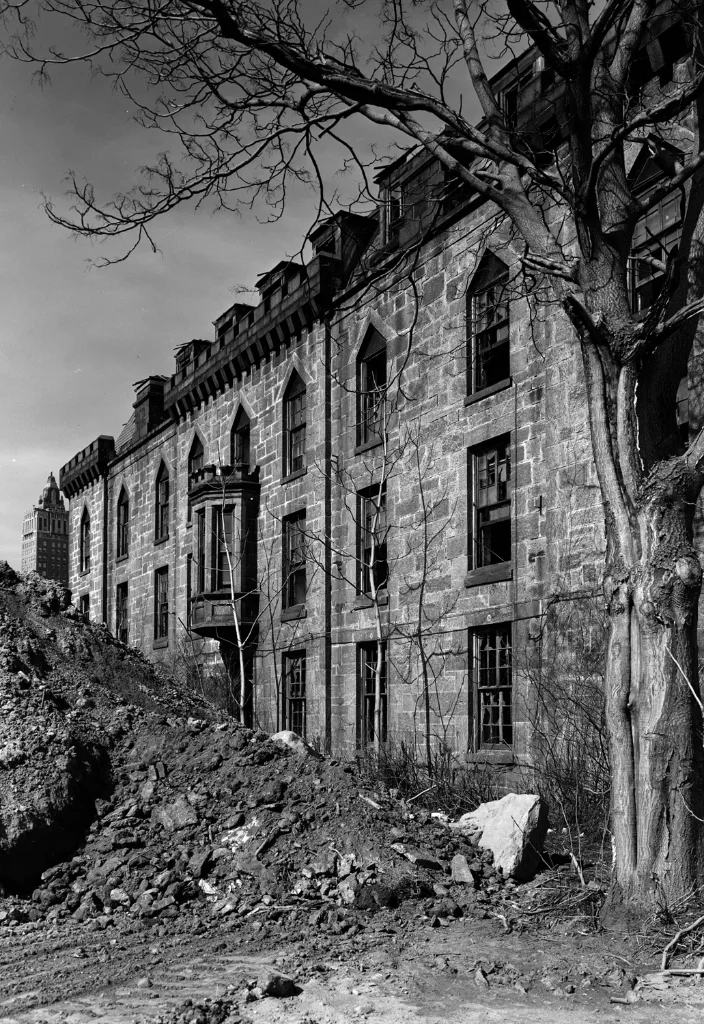
Historic American Buildings Survey
The last naturally occurring case
Ali Maow Maalin, a hospital cook in Somalia, becomes the last person known to contract naturally occurring smallpox. He survives.
The last recorded death
Janet Parker, a medical photographer in Birmingham, England, dies after exposure to smallpox virus in a laboratory accident. She is the last known person to die from smallpox.
1980
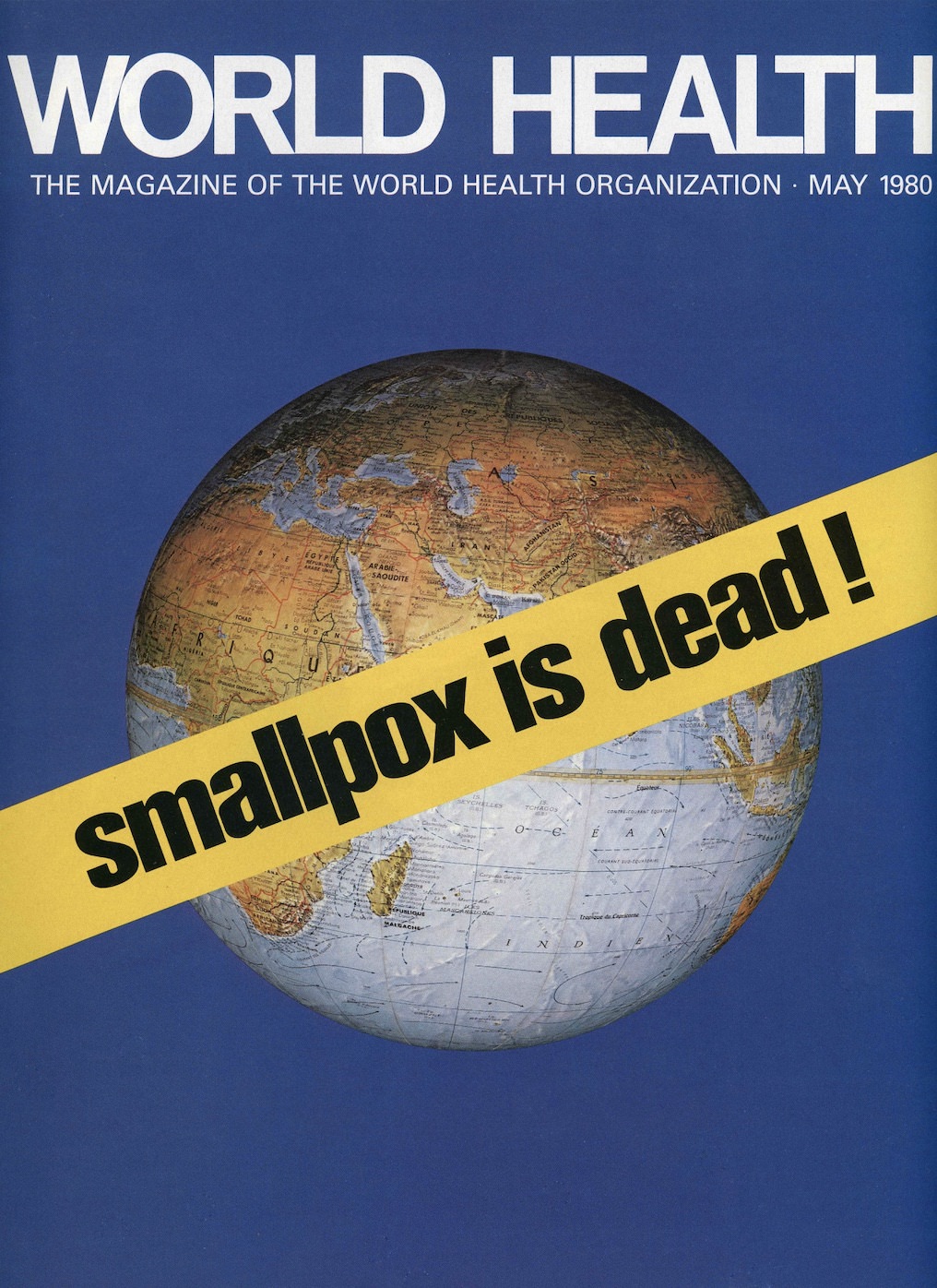
Smallpox is declared eradicated. The World Health Assembly makes the declaration on May 8, 1980.
The ruin enters the New York State Register. The same year, the Smallpox Hospital is entered on the State Register of Historic Places.
The walls are illuminated
Friends of Roosevelt Island Landmarks installs floodlights to illuminate the ruin.
A section of the wall collapses
A winter storm causes a large section of the north wall to collapse. Emergency shoring and bracing are installed.
A new structural survey begins
New York State Parks supports a structural survey by Walter B. Melvin Architects to assess the condition of the ruin.
New York faces another epidemic
A new pandemic fills hospitals across New York City. Healthcare workers confront a disease for which there is no established treatment or vaccine.
The ruin
The Smallpox Hospital remains fenced off and closed to the public.
Research and sources
Research for this timeline included the Roosevelt Island Historical Society, the Roosevelt Island Operating Corporation, the New York Public Library, the New York City Municipal Archives, the Library of Congress, and the World Health Organization.
- Katherine Greider, research on Roosevelt Island, Louis Kahn, and Four Freedoms State Park, conducted for the Four Freedoms Park Conservancy, 2013–2017.
- Stanley M. Aronson and Lucile Newman, Smallpox in the Americas, 1492 to 1815: Contagion and Controversy. Brown University.
- National Geographic, Conquered Killer.
- World Health Organization, History of smallpox vaccination. World Health Organization.